


Bernhardt Muller, The Architect
The original homes and key structures of Opa-locka were designed to look as if they had been lifted straight from the pages of Arabian Nights — as if the fantastical Hollywood sets of distant lands had become real, livable spaces.
While the interiors of most modest homes followed common cottage layouts, typically featuring 2–3 bedrooms, it was the exterior façades where architect Bernhardt Muller and his associates brought Glenn Curtiss’ vision to life. Each design was thoughtfully crafted to harmonize with the street on which it stood, all of which were named after characters from the Arabian Nights tales.
Between 1926 and 1927, Muller produced nearly 100 residential, commercial, and municipal designs, ranging from the whimsical to the grandiose. Some of the most remarkable examples include the Opa-locka Company Administration Building, the swimming pavilion, the archery club, and the Bush Apartments on Sesame Street.
To appreciate the city’s distinctive style, take a closer look at the geometric ornamentation and architectural features that define Moorish Revival design, visible throughout Opa-locka’s historic structures.

About Opa-locka Chief Architect Bernhardt Emil Muller
Opa-locka’s chief architect, Bernhardt Emil Muller, A.I.A., was born in Fremont, Nebraska, on December 27, 1878. A student of the prestigious École des Beaux-Arts in Paris, Muller traveled extensively across Europe before returning to the United States, where he worked as a draftsman and designer. In 1914, he established his own firm in New York City.
By the early 1920s, Muller had gained a strong reputation designing Mediterranean-style homes in the Miami area — work that caught the attention of Glenn Curtiss, who was seeking a talented architect to bring his Arabian Nights-inspired vision for Opa-locka to life.
Select ideas and drawings for Opa-locka reportedly began arriving in Florida from Muller’s New York firm in late 1925, likely sent to Curtiss’ home in Country Club Estates (now Miami Springs). Although Muller may have initially preferred a Tudor/English-style approach, the collaboration between him and his two associates proved ideal for transforming Curtiss’ fantastical vision into reality.
After Curtiss’ death in 1930, Muller continued his work in the Northeast, including interior designs for luxury ocean liners. He passed away in September 1964. According to the American Architecture Directory of 1956, his other work included churches and suburban houses throughout New Jersey.


Arabian Nights Stories & Themes For Buildings
“The Talking Bird” - Opa-locka Company Administration Building; fashioned after the palace of Emperor Kosroushah; garden design inspired by the Garden of the Princess Periezade - “Take of the Two Cadettes”
“The Stone City” - Hurt Building
“Prince Ahmad and the Peri-Banu” - Opa-locka Archery Clubhouse
“Ali Baba and the Forty Thieves” - Opa-locka Golf Clubhouse
“Aladdin and His Lamp” - Opa-locka Seaboard Railway Station and surrounding homes
“Khudad and His Brothers” - The First Gas Station on Opa-locka Boulevard
“Tale of Zayn Al-Asnam” - Opa-locka Bank


Crenellated and Flared Parapets
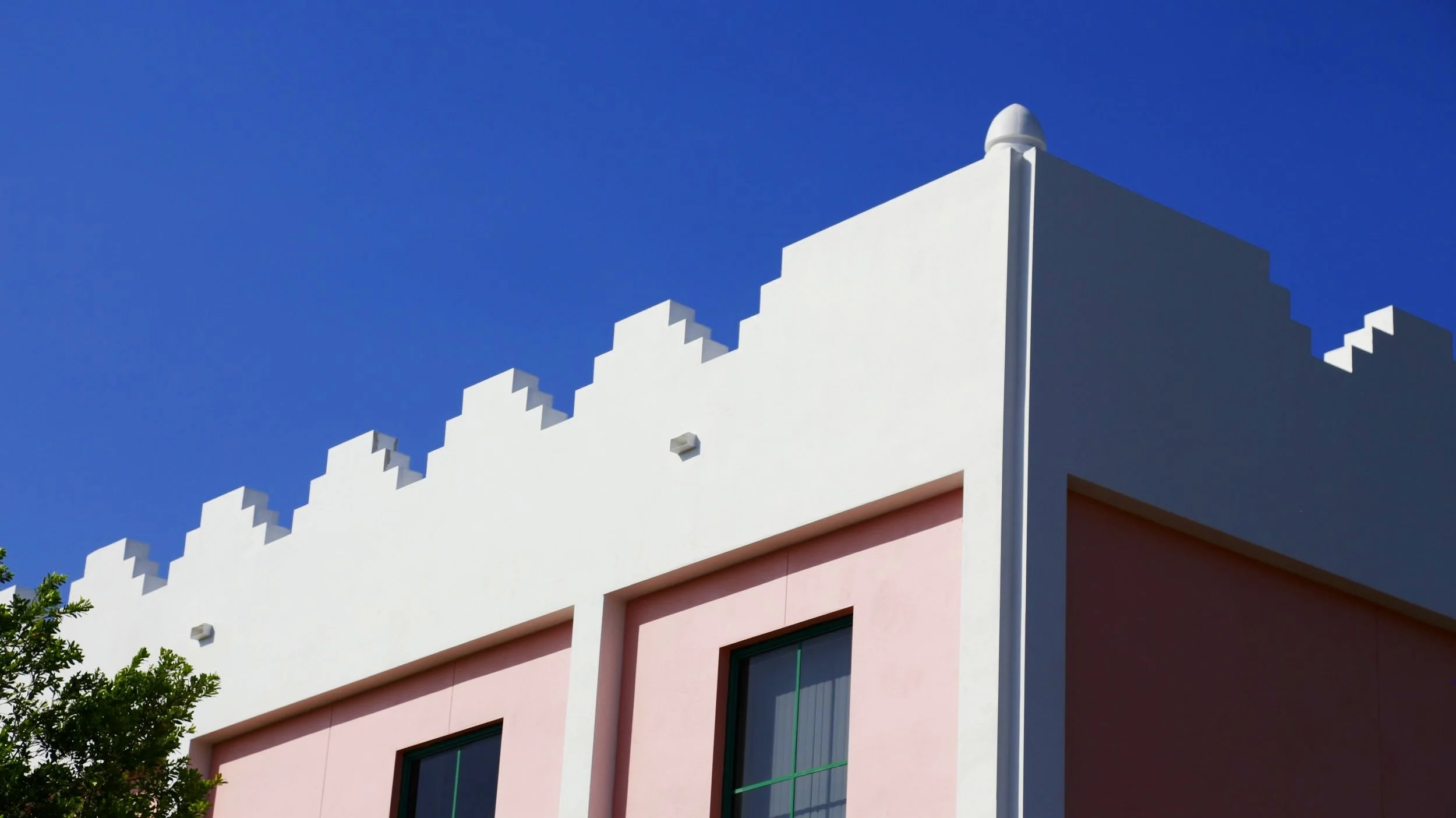
Let’s start with the word “parapet.” According to Dictionary.com, a parapet is “a low wall or railing to protect the edge of a platform, roof, or bridge.” The other meaning is “a wall, rampart, or elevation of earth or stone to protect soldiers.” The act of “crenellation” is. “the cutting of crenels into a previously solid and straight parapet wall,” or, according to TREANORHL, “having a parapet wall in the form of a battlement with alternating openings (embrasures or crenels) and raises sections (merlons) located at the top of the wall or roof). The buildings in Opa-locka that still maintain their original crenelated parapets are of various shapes, some tiered, others rounded, and some with no crenallation but rather “flared” ends to the corners of the sides of the building or chimney.

Minarets
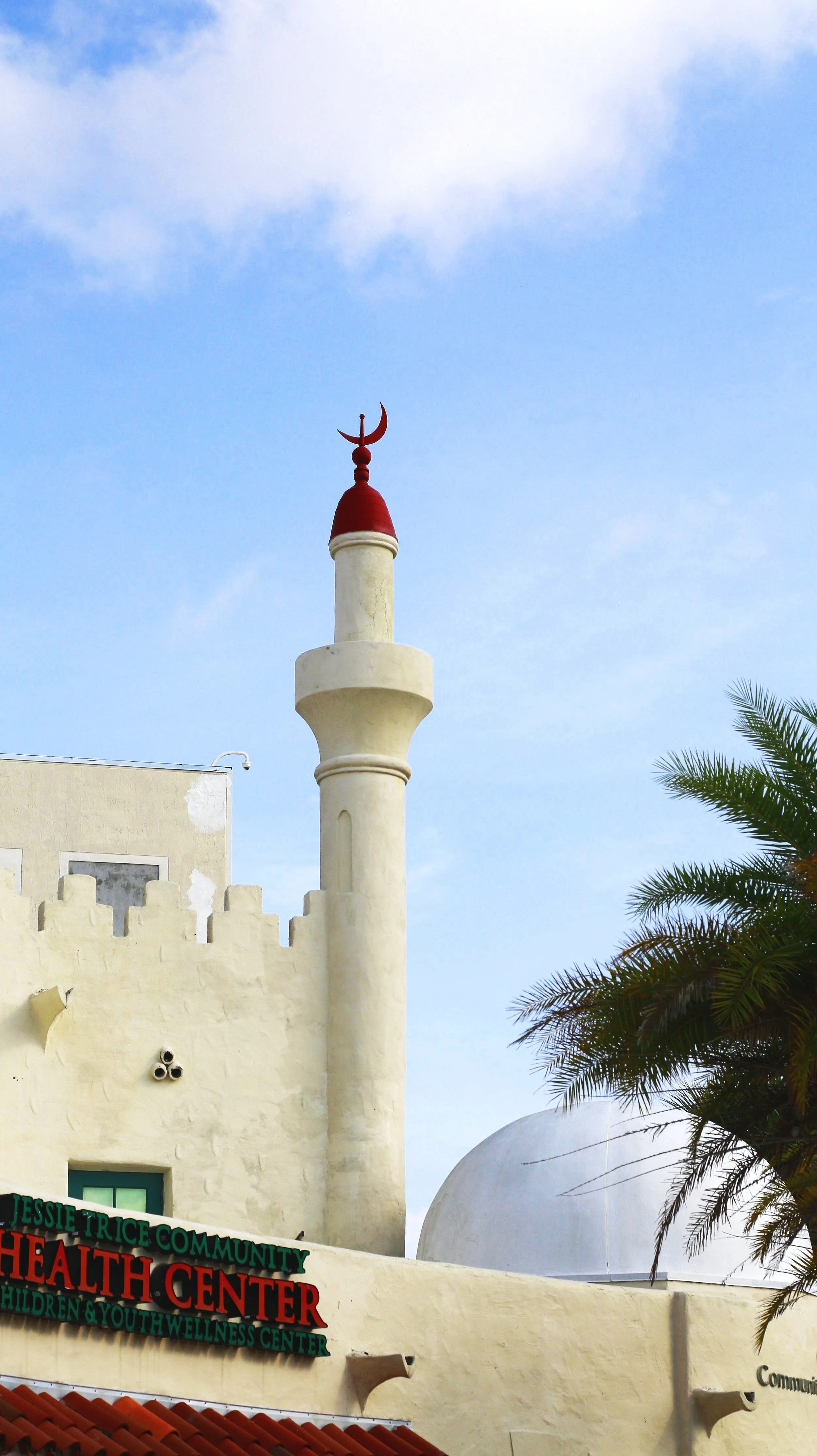
A less common but certainly exceptional feature is that of a minaret, a tower typically built as part of or adjacent to mosques. As is the case with Moorish Revival design, some elements denote a religious connotation or purpose. A true minaret is often used for the projection of a Muslim call to prayer. The minarets on top of the Opa-locka Company Administration Building have accessibility to the top, and during the first Arabian Nights Fantasy festival On January 8, 1927, members of the community rose to the top of the city to exclaim their enthusiasm for their town.

Domes

Arguably the most distinct and eye-catching feature of any building that still retains it. The dome is a grand feature that, in true Revival fashion, is scaled down to fit the modest structures they were designed for. The Hurt Building, Opa-locka Seaboard Railway Station, Opa-locka Company Administration Building, and one historic property in the city are the only structures that maintain their original or recreated domes. Most homes in the city’s masterplan had domes, either above the porte corche (carport), living room, or above the front door. Over time, the domes, made of a curved wood frame and stucco mesh, would meet their demise thanks to the harsh elements, resulting in extensive water damage inside the homes.
Horseshoe Arches (Moorish Arch, Keyhole Arch)


An exceptional and distinct Moorish quality is that of the windows or door entries that have a horseshoe shape to them, some with rounded tops, others with pointed ones. Examples of these can be found at the Opa-locka Seaboard Railway Station, as well as a handful of homes throughout the community.

Voussoir

Any of the pieces, in the shape of a truncated wedge, that form an arch or vault, with the best example of this seen at the Opa-locka Company Administration Building.

Ablaq

Alternating rows of colors of stone, a statement made around the arches of the Opa-locka Company Administration Building, and previously on many residences specifically around window casements. These striped colors would fluctuate from light to dark and be a characteristic of the facade that would complement other structural features. Although ablaq usually means the colors are of different stone materials, Opa-locka buildings would be done by a stucco imprint that would later be painted.
Continuing The Legacy
It’s not just the historic properties that display Opa-locka’s signature Moorish Revival elements — from soaring domes to crenellated parapets. As you explore the city, you’ll notice that even newer apartment buildings, gas stations, auto shops, pawn shops, and other storefronts have embraced this distinctive architectural style, paying homage to the city’s unique and imaginative design heritage.


